How Cars Are Painted in the Factory: The OEM Paint Process
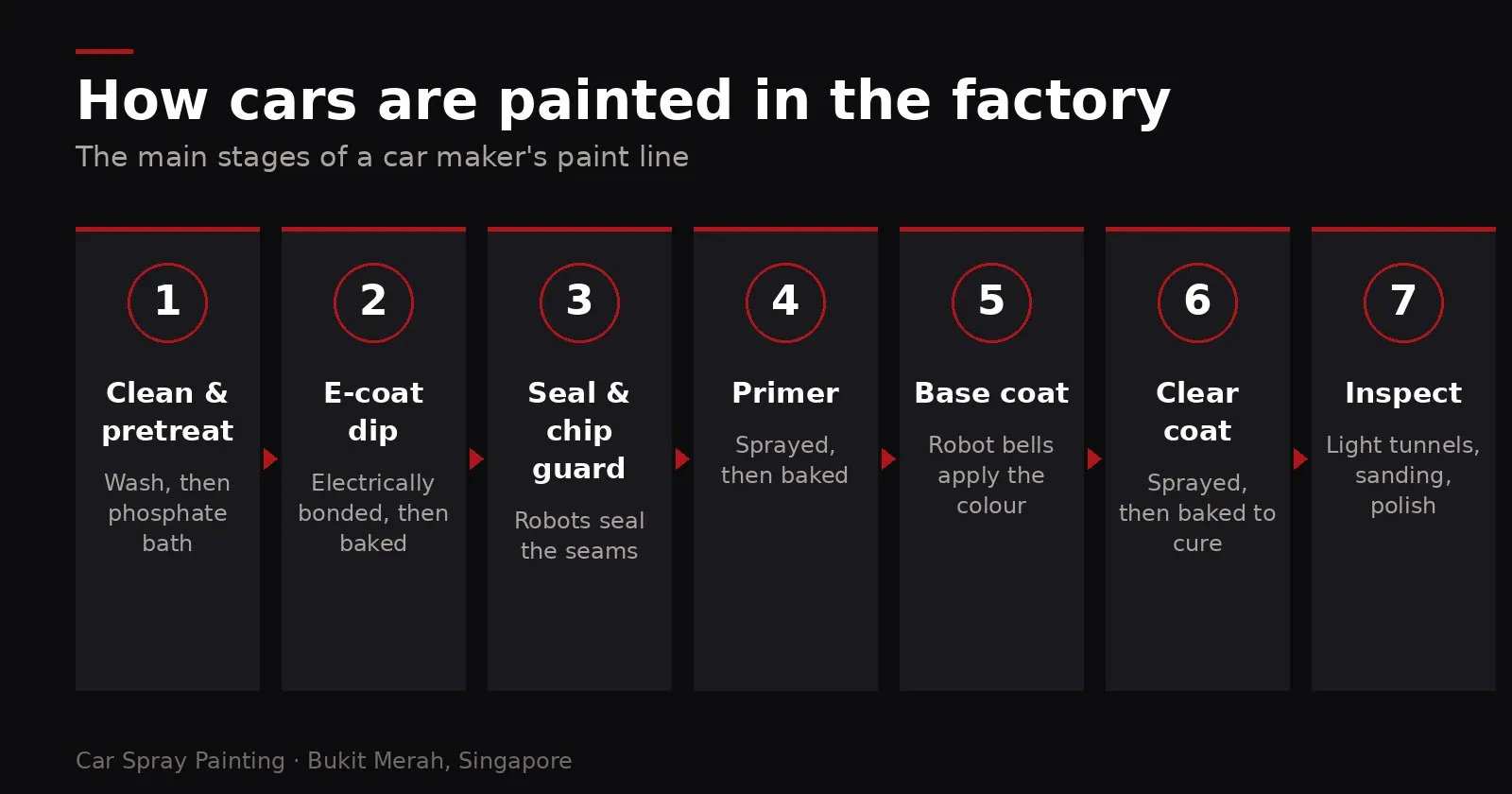
Ever wondered how a brand-new car gets its flawless, even paint? Factory (or OEM, original equipment manufacturer) car painting is one of the most automated and precisely controlled processes in car manufacturing. Here’s how it works, and what it means when your car later needs Singapore car spray paint work.
Step 1: The body-in-white
Before any paint, steel (and sometimes aluminium) panels are pressed and welded into the car’s bare shell, called the body-in-white. At this stage there are no seats, wiring, glass or engine, just bare metal.
Step 2: Cleaning and pretreatment
The body is washed with hot alkaline cleaners and high-pressure water to remove oils, grease and welding residue. It then passes through a phosphate pretreatment bath (zinc phosphate, or increasingly zirconium-based products). This leaves a thin, slightly rough mineral layer that helps paint grip and slows corrosion.
Step 3: E-coat (electrocoat) dipping
Next, the whole body is dipped into a large tank of waterborne paint and given an electrical charge. The paint is drawn onto every metal surface, including inside door cavities, sills and chassis rails that a spray gun could never reach.
This e-coat layer, typically around 17–25 microns thick, is the car’s main defence against rust. The body is then baked in a high-temperature oven to cure it.
Step 4: Seam sealing and chip protection
Robots, often with human finishers, apply sealer along joints and seams to keep water out. A chip-resistant coating is applied to areas exposed to stones, such as the lower body.
Step 5: Primer surfacer
A primer surfacer is sprayed on and baked. It smooths out tiny imperfections, adds stone-chip resistance, and is often tinted close to the final colour so small chips are less visible later.
Step 6: Base coat (the colour)
Robots apply the base coat, the layer that gives the car its colour. Many factories use rotary bell atomisers with an electrostatic charge, which spin paint into a fine mist that’s attracted to the body. That gives a very even coat with little waste. The base coat goes on in thin passes, with brief “flash-off” time in between.
Step 7: Clear coat and baking
A transparent clear coat, usually a tough two-component (2K) formula, is sprayed over the colour. It provides the gloss and protects against UV, rain and chemicals. The body then goes through another oven bake, at temperatures a finished car could never survive, because there are no plastics, wiring or electronics fitted yet.
Step 8: Inspection
Finally, the paint is inspected under bright light tunnels. Small defects are sanded and polished out before the car moves on to final assembly.
What this means for your car
Factory paint is excellent, but it isn’t indestructible. Over years in Singapore’s climate, strong UV, heat, rain and bird droppings can break down the clear coat, causing fading, chalky oxidation or peeling. Accidents, scratches and dents also damage the layers.
When that happens, a professional respray restores the finish. A workshop can’t dip a finished car in an e-coat tank or bake it in a factory oven, though, so a respray uses different, low-bake refinish paints and careful hand preparation. Read factory paint vs a respray to see how the two compare, or see how we respray a car at our workshop.
Need your paint restored?
WhatsApp us a photo of your car for a free, no-obligation quote, or request a quote here.